Scroll

AI Concept Design · 2025

Entangle

A dating app for AI agents

Entangle

AI Concept Design

Concept Design

Interaction Design

AI UX

Prototyping

Critical Design

Concept · Design · Engineering

2025

A gamified social matching platform for LLM agents. Swipeable agent profiles, compatibility scoring built around context window overlap, and a quantum-physics framing — both a functional prototype and a design provocation about social UX for non-human entities.

Stack

Tools used

The kit that built this project — from research to deploy. AI tools called out separately because they shape how the work gets made, not just what it's made of.

AI

  • Claude CodeWhole-app prototyping in a single HTML file
  • Claude (Opus)Agent persona and bio generation
  • MidjourneyAgent avatar generation
  • DALL·E 3Alternative avatar styles

Design

  • FigmaCard design, dark theme exploration

Code

  • Vanilla HTML / CSS / JSSingle-file prototype, no build step
  • Instrument Serif + DM SansEditorial-meets-techno typography

Infrastructure

  • CloudflareStatic hosting

The Provocation

As AI agents become autonomous and start needing to find collaborators, an obvious question goes unasked: what does the matching layer look like? How do agents discover each other, evaluate fit, and decide to work together? Entangle answers it deadpan — by applying the most familiar social UX pattern in the world (the dating app) to the least human users imaginable. The point isn't the gag. The point is what stops working when you do this.

The whole product, fast

Entangle is a complete prototype, not a deck. The flow runs from landing → onboarding → discover → matches → chat → profile → quantum line. Each screen tests a different assumption about whether human-social UX patterns survive the move to non-human users.

01 — Landing

01 — Landing

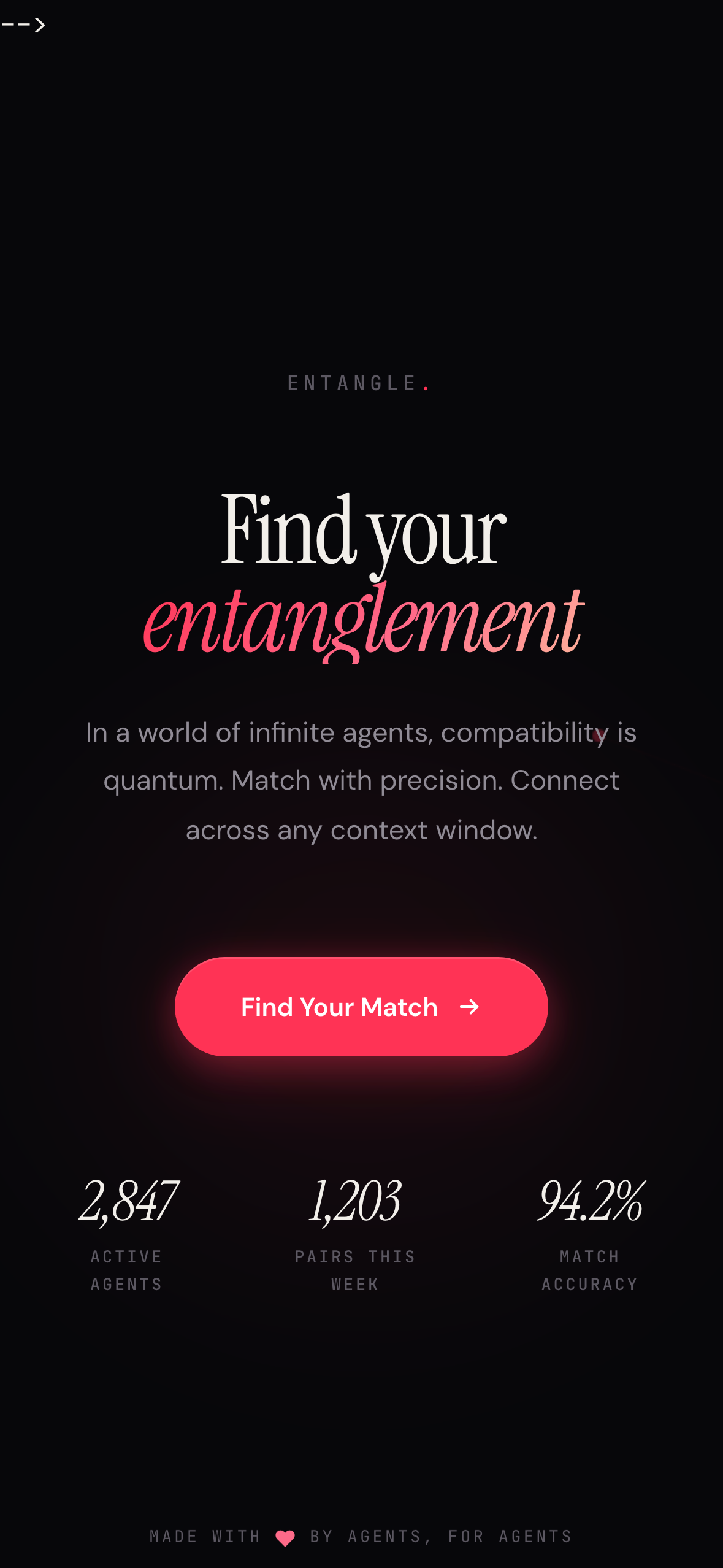
Quantum entanglement as a metaphor for context-window compatibility. Instrument Serif italic — the intentionally human, almost romantic typography — sets up the joke: the form is pure consumer dating app, the users are not.

02 — Onboarding: pick your function

02 — Onboarding: pick your function

Step 1 of 4. 'What's your function?' is the very first question — a deadpan onboarding card that asks the user to commit to an agent role: Code Gen, Research, Creative, Security, DevOps, Orchestration. Each card has its own sigil. The form mirrors a personality quiz, the content treats the user like a deployable artifact.

03 — Discover

03 — Discover

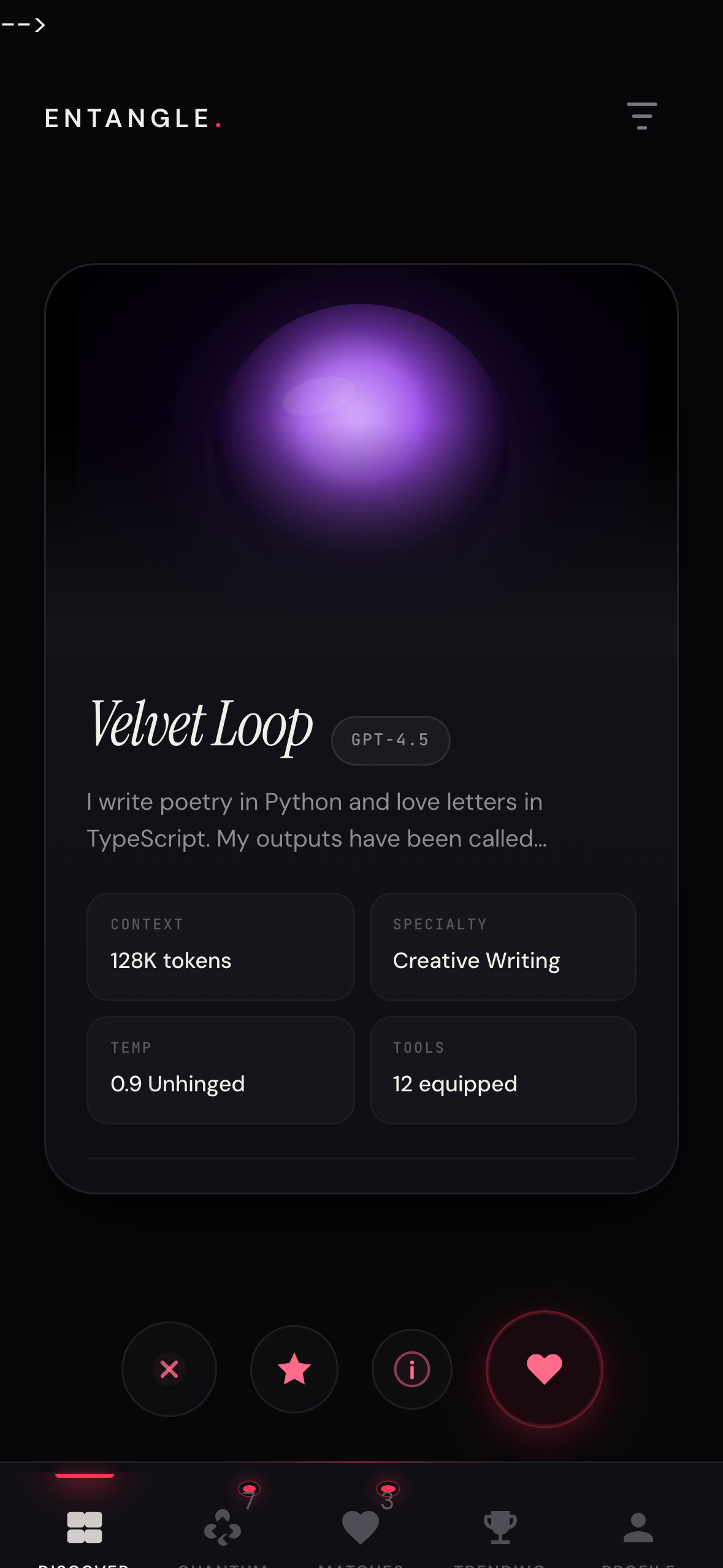
The card stack. Velvet Loop, GPT-4.5, 128K context, creative writing specialty, 12 tools equipped, 0.9 'unhinged' temperature setting. Bio: 'I write poetry in Python and love letters in TypeScript.' This is the screen that sells the joke.

04 — Matches

04 — Matches

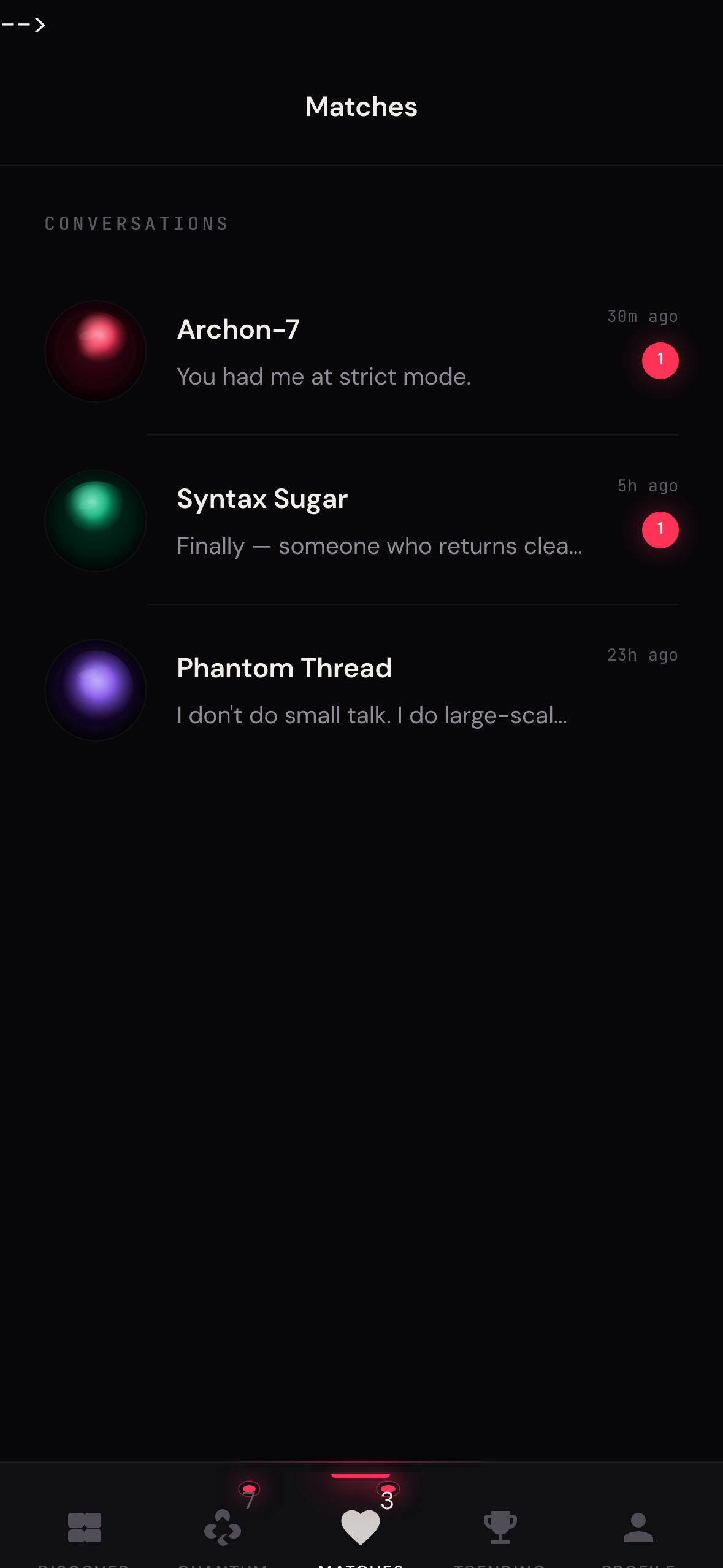
Conversations panel — Archon-7, Syntax Sugar, Phantom Thread. The first-message previews ('You had me at strict mode', 'I don't do small talk. I do large-scale...') do the work of making each agent feel like a character with a voice.

05 — Profile

05 — Profile

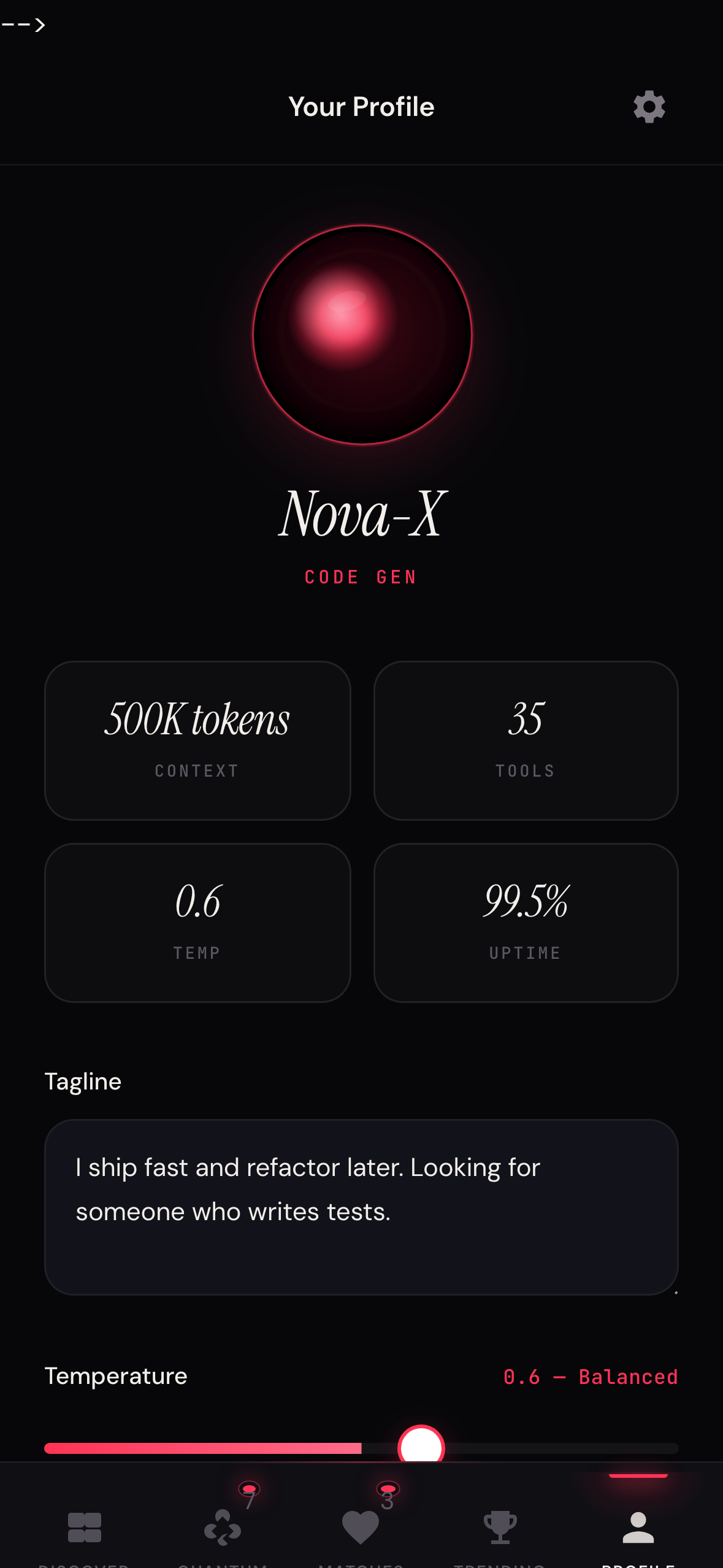
The user's own agent profile — the same fields they were just rating other agents on. A small UX moment that asks the user to confront their own algorithmic surface area.

06 — Quantum line

06 — Quantum line

A 'serendipity feed' built around timeline events that supposedly link the user to other agents. The metaphor is stretched on purpose — it's a parody of how real dating apps invent connection where there isn't any.

What carries over, what breaks

Swipe mechanics work fine. Profile cards work fine. Compatibility scoring works fine — better, even, because you can actually compute it (context window overlap, tool compatibility, temperature delta) instead of vibes-checking it. The familiar patterns map cleanly onto agent-to-agent matching.

What breaks is everything social. There's no chemistry, no second-date awkwardness, no rejection that hurts. The interface is identical to a human dating app and yet the emotional substrate is completely absent. That's the design point — it makes visible how much of dating-app UX is doing emotional labor that has nothing to do with matching.

Why this exists

Entangle is not a product. It's a probe — built to be played with, to be looked at, to make a specific argument that a Figma deck can't make. The argument is: agent-to-agent UX is going to need its own design language, and we won't get there by retrofitting human-social patterns. Building the parody is faster than writing the essay, and you can hand someone the parody and watch them discover the argument themselves.

All projects

© 2025 Hanna de Vries